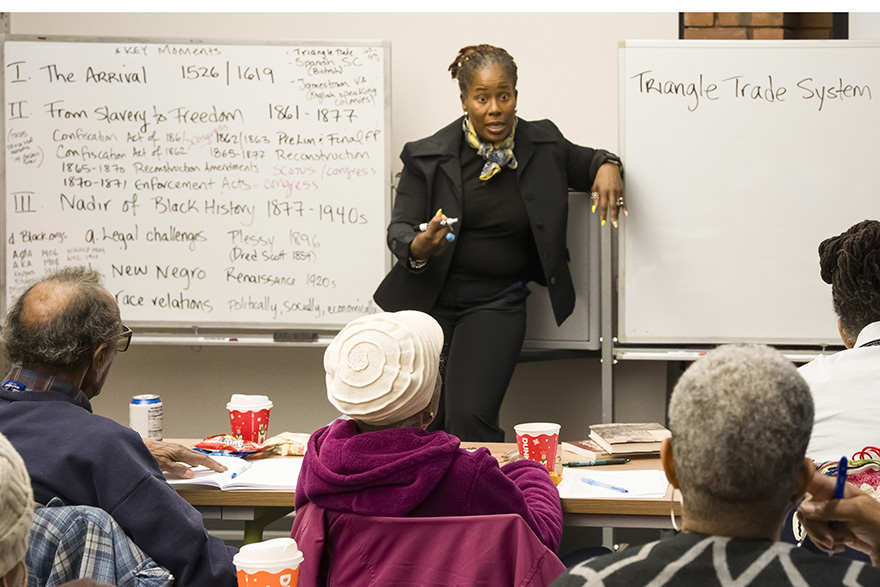
The Association for the Study of African-American Life and History (ASALH), an organization founded by Dr. Carter G. Woodson in 1915, is credited with the establishment of Black History Month. (Learn more about its history here.) Senior Planet talked to Dr. Karsonya Wise Whitehead, its National President since January 2025, about the organization and her role. She is also a Professor of Communication and Africana Studies at Loyola University in Maryland. Dr. Whitehead carries forward a mission that spans over a century: to research, preserve, interpret, and disseminate Black history across all communities and throughout the entire year, not just during Black History Month.
How did you get involved with this work?
My father was involved in the Civil Rights Movement in South Carolina, and so I’ve always been concerned and involved in the ways in which we teach our history, we promote our history, and we protect our history. It was an interesting time to be elected as a national president…because it was during the changes that were happening politically in the country, and it really was a moment for us to make a very bold proclamation that Black history will continue to be celebrated during February, it will continue to be uplifted, protected, promoted and preserved during the rest of the year.
When you look back at the organization’s origins, what core values or intentions still guide you in this work?
For ASALH, our mission is uniquely stated in our title, in the name of who we are, that we are pulling together people within spaces and ideas to be able to promote our history and how Black history is uniquely tied to the American historical narrative, and that without Black history, there is no American history, because we are an essential part of the story of the development of how America became America.
We are uniquely committed to disseminating Black history, whether it’s through our journal, whether it’s through our bulletin, whether it’s through pulling together our Black History Month, or through our annual conference, but we are making sure that no matter where people are, they’re able to connect with ASALH.
What challenges does the organization face?
Black History is under attack. Our history cannot be erased. It was not written in pencil. It was written in pen, and then that’s the pen that was filled with the ink and the blood of our ancestors. So what I tell people is they need to focus on doing their part, and your part is learning the history. Your part is teaching the history. Your part is uplifting the history. You cannot focus on those who are seeking to destroy us. You have to focus on those who are doing the work to preserve us.
How can older adults get involved, especially to continue to honor that passage of knowledge?
There are three things that people can do. One is they need to join ASALH. Membership is important. Being a part of the conversation is important. You can’t make change when you’re outside of the room. You need to be inside the room. That’s what Shirley Chisholm said: if they don’t have a chair for you, you bring your own chair inside the door. So joining ASALH, too, is learning our history; get those essential documents, whether it’s our journal or bulletin; and pour yourself into the work of learning our history. The third thing is, you have to build up the muscle of resistance. It is not something that when you’re in a situation, like a movie and everything kicks in, and you know what to do. You actually have to train yourself on what does it mean to resist.
Want to trace your own family history? Check out Senior Planet’s February 24 session on Digital Genealogy Tools. Details are here.
What does aging with attitude mean to you or to ASALH?
Recognizing that as long as you are here, you still have a purpose, you still have a voice, and you still have work to do. You make that commitment to take care of yourself, your mind, your body, making sure that you’re putting in the good work so that you can continue to contribute to this country. If you are still here and you’re aging with grace and with purpose, then that means you have work to do. You have knowledge that can be passed on. You have experiences that you can share. You still have energy and you still have enthusiasm, and you have the wisdom that comes from the years of having to live through this struggle.
FOR MORE INFORMATION
Attend their February luncheon on February 28, or get involved with an ASALH branch near you.
Want to know more Black History? Check out Senior Planet’s features on The National Black Doll Museum, The African American Cultural Garden, The True West: America’s Black Cowboys, Bonnetta Adeeb Shows Seeds of Resistance, and join us on February 18 for a virtual tour of the legacy Martin Luther King, Jr. in Washington DC. Details are here.
YOUR TURN:
What do you do for Black History Month? Share your ideas in the comments!
Photo: Marty Williams Photography
 NaBeela Washington, an emerging Black writer, holds a Master’s in Creative Writing and English from Southern New Hampshire University and Bachelor’s in Visual Advertising from The University of Alabama at Birmingham. She has been published in Eater, The Cincinnati Review, and others. Learn more at nabeelawashington.com

COMMENTS
Sign Up for Newsletters
There’s always a lot going on in the Senior Planet universe. Get our newsletters to make sure you never miss a thing!
Sign Up Now
Join Senior Planet Community
Senior Planet Community is our social media platform designed specifically for older adult users. Engage in thought-provoking discussions, make new friends, and share resources all on a safe and ad-free platform.
Join the Conversation Today
Upcoming Online Classes
Events
Calendar of Events
Start your week off right with a preview of the week's upcoming programs and a guided meditation session!
Start your day with a short morning stretch!
Registration required.
Discover what you can do with online and mobile banking!
Use bodyweight, bands, and dumbbells to build your strength.
Learn about devices and apps that can help you get more Zzz's
Activate the joints and muscles and increase mental focus during this exercise class.
Start your day with a short morning stretch!
Come learn how your phone can count your steps and check your heart rate!
TikTok can be a source of fun, creativity, and information. Learn about this social media platform gaining popularity.
Follow various cues to develop body alignment and breath awareness.
Start your day with a short morning stretch!
Registration required.
You CAN leave home without your wallet! Learn about popular digital wallets and their many uses.
Use bodyweight, bands, and dumbbells to build your strength.
Join Senior Planet and our tour guides from Discover Live for a virtual visit to Louisiana!
Get your heart pumping during this fun, high-energy workout!
Activate the joints and muscles to become limber and increase balance during this exercise class.
Start your day with a short morning stretch!
Learn about tech you can wear and what it can do for you!
Registration required.
Curious about your family's history? Fill in the gaps using digital genealogy resources!
Looking for a new creative outlet? Learn about popular, free platforms to design cards, flyers, and more online.
Join this special class that combines gentle movement with a focus on harmonizing your mind, body and breath.
Start your day with a short morning stretch!
Don't want to pay for software? Learn how Google's free tools have you covered.
¡Consiga hacer algo más que figuras de palitos y haga que su imaginación cobre vida con generadores de imágenes de IA!
Relax your mind and strengthen your body with this gentle exercise class.
Join this session for a fun workout that will boost your strength, flexibility, and mobility!
Come learn how smart technology can help you maintain your independence in your own home.
Don't want to cook? Learn about meal kit services that take the stress out of meal time!
Don't want to go out? Learn about some popular apps to get food delivered to your front door.
Start your week off right with a preview of the week's upcoming programs and a guided meditation session!
Start your day with a short morning stretch!
Get an inside look at Senior Planet’s redesigned website and learn to use its features!
Use bodyweight, bands, and dumbbells to build your strength.
Registration required.
Learn how to use emojis, GIFs, and more to quickly say what you mean!
Activate the joints and muscles and increase mental focus during this exercise class.
Start your day with a short morning stretch!
See who you are talking to with video chat apps!
Ready to ditch the filling cabinet and store your documents virtually? Join this lecture on Digital Vaults to learn how!
Follow various cues to develop body alignment and breath awareness.
Start your day with a short morning stretch!
Thinking about hosting a group video call? Come to this lecture for an overview of hosting Zoom meetings.
Use bodyweight, bands, and dumbbells to build your strength.
Join Senior Planet and our tour guides from Discover Live for a virtual preview of London to learn about its culture, daily life, and what to know before you go.
Get your heart pumping during this fun, high-energy workout!
Activate the joints and muscles to become limber and increase balance during this exercise class.
Start your day with a short morning stretch!
Learn about online tools to jump-start your start-up.
Registration required.
Overwhelmed by the choices of a new computer? We'll help you simplify so you can decide!
Learn what Podcasts are and where to find them!
Join this special class that combines gentle movement with a focus on harmonizing your mind, body and breath.
Start your day with a short morning stretch!
Stumped? Find what you're looking for on Reddit!
¡No tenga miedo, porque la IA está aquí... ¡para (intentar a) ayudar!
Relax your mind and strengthen your body with this gentle exercise class.
Activate the joints and muscles and increase mental focus during this exercise class.
Start your day with a short morning stretch!
Don't want to pay for software? Learn how Google's free tools have you covered.
Learn how to keep your MyChart and other health accounts secure and private!
Follow various cues to develop body alignment and breath awareness.
Start your day with a short morning stretch!
Caregiving is hard, but tech tools can make it easier! Join us in this lecture to find out how.
Use bodyweight, bands, and dumbbells to build your strength.
Where can you find cute pets, news, how-to videos, and more? YouTube, of course! Join us for an intro to YouTube.
Take a virtual tour of Washington, DC with Senior Planet and Discover Live to explore Dr. King’s legacy on the National Mall.
Activate the joints and muscles to become limber and increase balance during this exercise class.
Start your day with a short morning stretch!
Tired of juggling paperwork, deadlines, and day-to-day chaos? Discover the user-friendly software tools that can bring clarity, control, and peace of mind to your business.
Stay independent and on the move! Discover how Lyft Silver makes getting around easy without needing to drive.
Stay sharp with technology! Join this lecture to learn about different ways to engage your brain.
Join this special class that combines gentle movement with a focus on harmonizing your mind, body and breath.
Start your day with a short morning stretch!
Puede que ver ya no signifique creer. Venga a aprender a identificar ultrafalsos (deepfakes) y voces clonadas para no caer en el engaño digital.
Love the great outdoors? Come learn how smartphone apps can enhance your outdoor hobbies!
Relax your mind and strengthen your body with this gentle exercise class.
Join this session for a fun workout that will boost your strength, flexibility, and mobility!
Come learn how your phone can count your steps and check your heart rate!
Don't just Google it! Use these reputable health info websites instead.
Learn how fitness apps can help you track and conquer your goals!
Start your week off right with a preview of the week's upcoming programs and a guided meditation session!
Start your day with a short morning stretch!
Come learn about QR codes, augmented reality apps, and more!
Use bodyweight, bands, and dumbbells to build your strength.
Will your digital content and social media pages live on forever? Come learn about your digital legacy options!
Activate the joints and muscles and increase mental focus during this exercise class.
Start your day with a short morning stretch!
Are you scam savvy? Come to this lecture to learn about fraud and scams and how to protect yourself against them.
Are you paying for TV channels you don't watch? Learn why people are "cutting the cord" and using streaming services instead!
Follow various cues to develop body alignment and breath awareness.
Start your day with a short morning stretch!
Faster is not always better! Come learn about home internet options so you only pay for what you need.
Use bodyweight, bands, and dumbbells to build your strength.
Get your heart pumping during this fun, high-energy workout!
Learn what Podcasts are and where to find them!
Activate the joints and muscles to become limber and increase balance during this exercise class.
Start your day with a short morning stretch!
Learn how to stay safe while you surf the web!
Learn about platforms that make website building a breeze!
Concerned about viruses and malware? Attend this lecture to learn how to keep your device safe!
Join this special class that combines gentle movement with a focus on harmonizing your mind, body and breath.
Start your day with a short morning stretch!
Explore ways that tech can help you save money and manage your finances!
¿La IA hizo eso? ¡Venga a aprender sobre las herramientas de voz y video de IA!
Relax your mind and strengthen your body with this gentle exercise class.
Learn about tech you can wear and what it can do for you!
Use bodyweight, bands, and dumbbells to build your strength.
Learn about devices and apps that can help you get more Zzz's
Interested in meditation? Learn about the app's meditative sleep aids and how to connect with others who have similar goals in the Insight Timer Community!
Good Morning, Senior Planet!
Morning Stretch
Banking and Finance Apps at a Glance
Functional Strength Training
Intro to Sleep Technologies
Stronger Bones
Morning Stretch
Mobile Health Apps
Intro to TikTok
Chair Yoga
Morning Stretch
Introduction to Digital Wallets
Functional Strength Training
Virtual Tour: Mardi Gras, New Orleans, LA
Fit Fusion Workout
Balance/Strength
Morning Stretch
Wearables at a Glance
Digital Genealogy Tools
Graphic Design Tools
Qigong Flow
Morning Stretch
Google Workspace
Generadores de imágenes de IA
Taijiquan (Tai Chi)
Saturday Morning Boost: A Fun and Functional Workout
Technology for Aging in Place
Meal Kit Services
Food Delivery Apps
Good Morning, Senior Planet!
Morning Stretch
Sneak Peek: Exploring SeniorPlanet.org Demo
Functional Strength Training
Emojis, GIFs, and more!
Stronger Bones
Morning Stretch
Video Chat
Digital Vaults
Chair Yoga
Morning Stretch
Intro to Hosting on Zoom
Functional Strength Training
Virtual Pre-Travel Tour: London, England
Fit Fusion Workout
Balance/Strength
Morning Stretch
Digital Tools to Boost your Business
How to Choose a New Computer
Podcasts at a Glance
Qigong Flow
Morning Stretch
Reddit at a Glance
IA en todas partes
Taijiquan (Tai Chi)
Stronger Bones
Morning Stretch
Google Workspace
Protecting Your Medical Info Online
Chair Yoga
Morning Stretch
Tech Basics for Caregiving
Functional Strength Training
YouTube
Virtual Tour: The Legacy of MLK Jr. in Washington, DC
Balance/Strength
Morning Stretch
Essential Tech for Running Your Small Business
Booking Rides with Lyft Silver Demo
Digital Tools for Brain Health
Qigong Flow
Morning Stretch
IA y la desinformación
Outdoor Adventure Apps
Taijiquan (Tai Chi)
Saturday Morning Boost: A Fun and Functional Workout
Mobile Health Apps
Online Health Resources at a Glance
Fitness Apps
Good Morning, Senior Planet!
Morning Stretch
Smartphone Camera Uses Beyond Photography
Functional Strength Training
Digital Legacy at a Glance
Stronger Bones
Morning Stretch
Understanding Fraud & Scams
Streaming & Smart TVs
Chair Yoga
Morning Stretch
Understanding Internet Plans
Functional Strength Training
Fit Fusion Workout
Podcasts at a Glance
Balance/Strength
Morning Stretch
Protecting Your Personal Info Online
Website Builders at a Glance
Anti-Virus & Malware Removal Programs At a Glance
Qigong Flow
Morning Stretch
Saving Money with Tech
Generadores de voz y video de IA
Taijiquan (Tai Chi)
Wearables at a Glance
Functional Strength Training
Intro to Sleep Technologies
Getting Started with Insight Timer Demo
Recent Articles
Recent Comments